
ISP Management
How ISPs Can Reduce Missed Renewals and Improve Collections
· 9 min read · By the AgencyCare team
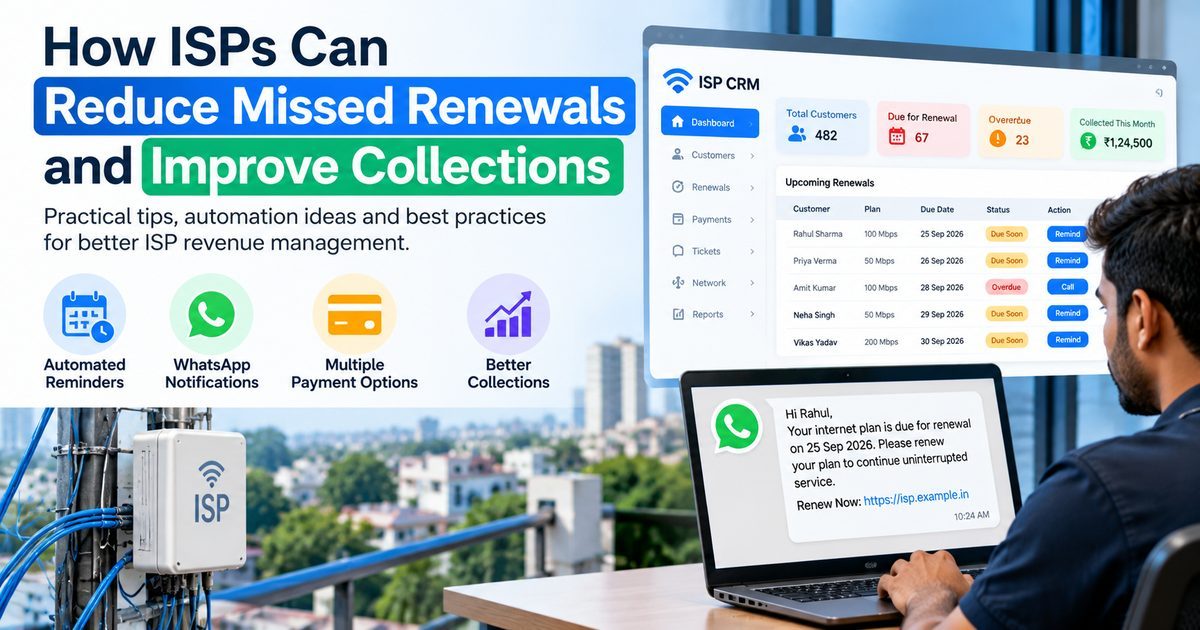
For most local and regional Internet Service Providers, revenue depends on one simple thing: customers renewing on time. When renewals are missed, money is lost twice, once from the unpaid period, and again when an unhappy customer quietly switches to another provider.
The good news is that most missed renewals are not caused by customers who want to leave. They happen because the customer forgot, didn’t know the exact expiry date, found it inconvenient to pay, or never got a reminder at the right time. All of these can be fixed with a clear process.
This guide explains a practical system any ISP can follow, whether you manage 300 subscribers in a spreadsheet or several thousand in dedicated software.
Why ISPs miss renewals
Before fixing the problem, it helps to know where it comes from. The most common causes are:
- No single list of expiry dates. Plans are spread across notebooks, spreadsheets and staff phones, so nobody sees the full picture.
- Reminders depend on memory. Someone has to remember to call or message each customer, and on busy days, they don’t.
- Paying is inconvenient. The customer has to wait for a collection agent or visit the office.
- Unclear grace-period rules. Customers don’t know when the connection will actually stop, so they delay.
- Unresolved complaints. A customer with a slow connection or an unanswered complaint is much less likely to renew.
- Collections aren’t tracked properly. Payments are collected but not recorded on time, so the list of “unpaid” customers is wrong.
1. Keep one reliable list of every subscriber’s expiry date
Everything else depends on this. Every active subscriber should have one record with their plan, start date, expiry date, payment status and contact number. If this data lives in five places, it will always be out of date.
Start by cleaning your existing data: remove duplicates, confirm phone numbers, and mark which connections are active, suspended or closed. It is tedious work, but it only needs to be done properly once.
2. Use a fixed reminder schedule
Reminders work best when they follow the same schedule every time, rather than whenever someone remembers. A simple schedule many ISPs use:
| When | Message | Channel |
|---|---|---|
| 5–7 days before expiry | Friendly heads-up with plan, expiry date and how to pay | WhatsApp / SMS |
| 2 days before | Reminder with a direct payment link or UPI details | WhatsApp / SMS |
| Expiry day | “Your plan expires today” with payment options | WhatsApp + call for important customers |
| 1–2 days after | Service paused / grace period notice and how to restore | Call |
| 7+ days after | Win-back message or call, ask why they didn’t renew | Call |
Two rules make reminders effective: stop as soon as the customer pays, and keep messages short and specific: name, plan, expiry date, amount and how to pay.
A simple example:
Hi Rahul, your 100 Mbps plan expires on 25 September. Renew now to avoid interruption: [payment link]. Already paid? Please ignore this message., [Your ISP name]
3. Use WhatsApp, the right way
Most subscribers in India read WhatsApp messages far more reliably than SMS or email. But sending hundreds of reminders from a personal WhatsApp number is risky: it’s manual, hard to track, and the number can be restricted for bulk messaging.
For automated reminders at scale, use the official WhatsApp Business Platform through an approved provider. Automated business messages use pre-approved templates, and customers should have agreed to receive messages from you, the easiest time to get that agreement is when a new connection is installed.
4. Make paying as easy as possible
Every extra step between the reminder and the payment loses some customers. Reduce the friction:
- Include a payment link or UPI details in every reminder.
- Accept UPI, cards and net banking, not just cash.
- Send an instant receipt on WhatsApp or SMS after payment, so the customer knows it worked.
- Offer longer plans (quarterly, half-yearly, yearly), fewer renewal moments means fewer chances to miss one.
5. Bring discipline to field collections
Cash collection by field agents is still common, and it is where money most often goes missing, usually through delays and errors rather than dishonesty. A few habits make a big difference:
- Record every collection at the moment it happens, ideally from a phone.
- Give the customer a receipt immediately.
- Reconcile each agent’s collections every day against cash deposited or transferred.
- Give each agent a clear daily list of customers to visit, sorted by area.
6. Set clear grace-period and reconnection rules
Decide your policy and communicate it in every reminder: how many days of grace (if any), when the connection is paused, and what the customer needs to do to restore it. Clear rules reduce arguments and encourage customers to pay before the deadline rather than after.
7. Fix complaints before the renewal date
A customer who has had an unresolved complaint in the last month is a renewal risk. Track every complaint as a ticket with an owner and a status, and review open tickets for customers whose renewal is coming up. Solving the problem, and telling the customer it’s solved, is often the most effective renewal reminder of all.
8. Track the numbers that matter
You can’t improve what you don’t measure. Review these every week:
- Upcoming renewals in the next 7 days
- Expired but not renewed connections, by area and by days overdue
- Renewal rate: renewals completed on time as a share of renewals due
- Collections by day, by payment method and by agent
- Open complaints older than 48 hours
Watching the trend matters more than any single number. If your on-time renewal rate improves month after month, your process is working.
9. Win back customers who didn’t renew
Customers who don’t renew aren’t always lost. A short, polite call a week after expiry, asking why they didn’t renew, often reveals a fixable reason: a billing mistake, a complaint, or simply that they forgot. Keep a note of the reasons you hear; patterns tell you what to fix.
10. Give every task an owner
Reminders, collections, complaints and win-back calls each need a named person responsible. Clear roles, and access limited to what each person needs, make it obvious when something is falling behind.
A simple weekly routine
- Monday: review renewals due this week and last week’s expired list.
- Daily: send scheduled reminders, reconcile field collections, update payment status.
- Mid-week: check open complaints for customers with upcoming renewals.
- Friday: win-back calls for connections expired 7+ days; review the week’s collections.
Spreadsheet or software?
You can run this system with a clean spreadsheet and a disciplined team, and that is a good place to start. As subscriber numbers grow, the manual work, building reminder lists, sending messages, issuing receipts and compiling reports, becomes the bottleneck. That’s when dedicated ISP billing or CRM software pays for itself. If you are comparing options, our ISP billing software checklist covers what to look for.
We are building AgencyCare ISP CRM around exactly these day-to-day tasks, renewals, reminders, payments, complaints and reports. It is currently in early access. We can also help you set up WhatsApp and workflow automation with the tools you already use. Talk to us and we’ll show you exactly what is available today.
FAQ
Frequently asked questions
When should an ISP send renewal reminders?
A simple schedule that works for many ISPs is: 5–7 days before expiry, 2 days before, on the expiry day, and 1–2 days after expiry. Adjust it to your plan lengths and customer base, and stop reminders as soon as payment is received.
Can we send renewal reminders on WhatsApp automatically?
Yes, through the official WhatsApp Business Platform (API) using a provider. Automated business-initiated messages must use pre-approved message templates, and customers should have agreed to receive WhatsApp messages from you.
How do we reduce cash collection problems with field agents?
Record every collection at the moment it happens, give the customer a receipt (SMS or WhatsApp), and reconcile each agent’s collections daily against deposits. Digital payments like UPI reduce the amount of cash that needs handling.
What reports should an ISP owner check every week?
Upcoming renewals for the next 7 days, expired-but-not-renewed connections, collections by day and by agent, pending payments, and open complaints older than 48 hours.
Do we need ISP software to do this?
You can start with a well-maintained spreadsheet and a disciplined routine. As the number of subscribers grows, dedicated ISP billing or CRM software makes reminders, receipts and reports much easier to manage consistently.